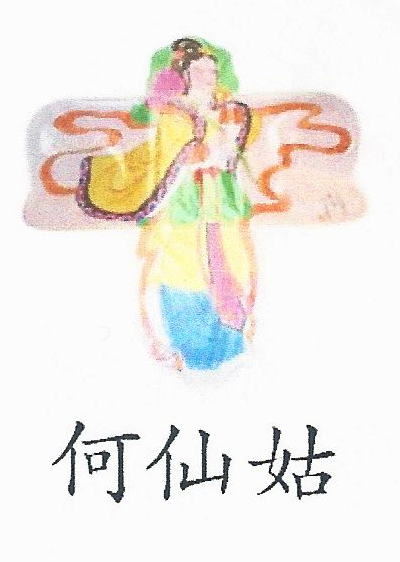
He Xiangu (He the Fairy Maiden)
He Xiangu is the only female member of the Eight Immortals, and although there are many stories involving her, there is no consensus about her origin. Her original name is always taken to have been He Hua, meaning lotus flower.
One of the more popular is that she was born into an impoverished family in Yunmuxi, Zengcheng County, Guangdong Province, in the reign of Empress Wu Zetian during the Tang Dynasty (618 to 907 A.D.). When she was a girl, the family was so poor that she gave her share of grain to her mother.
One night, she was visited in her dreams by a celestial who told her to eat mica powder to keep her hunger at bay. He Xiangu did as instructed, and after several years felt like a swallow, with swift and easy movements. She decided against marriage, and instead went to the hills every day to collect fresh fruit for her mother. As the girl didn’t eat cereals, her voice was unusual. When the court heard about He Xiangu, she was called to meet with the empress. However, on her way to the palace, she sailed up into the sky and became a celestial.
The following is my favourite story about the origin of He Xiangu. She was originally called He Hua (Lotus Flower), and lived with her family in a village north of Laoshan, near Qingdao. One day in June, she went to wash clothes with her sister-in-law. He Hua saw a peach floating in the water, but her sister-in-law insisted it was just donkey dung. To prove her wrong, little He Hua ate the peach. Suddenly, it began to rain, and the two of them ran home through the downpour.
Upon arriving home, her dripping sister-in-law, amazed, asked He Hua how it was possible for her to be dry. He Hua replied that she had simply ran through the gaps in the rain, instead of straight through it. News of the event quickly spread among the villagers, who decided that the peach must have been celestial, so in the spring they asked her what crops they should plant. He Hua advised them to plant crops with drooping heads. The villagers were unsure what this meant, but in autumn, those who had planted mullet had a bumper harvest.
The following summer, He Hua went to her family’s wheat field on the mountain slope, and started to reap about ten days early. The other villagers thought she was crazy, and when her father came up the mountain to scold her, she ran away to avoid beating. He tied the wheat into bundles and took it home. During the night, torrential rain destroyed the village’s wheat, and people wished they had done the same as He Hua.
The next morning, the weather was fme, but He Hua did not return. People searched far and wide for her, and after several days she was found in a cave high in the mountains. He Hua was sitting in a lotus-shaped bowl meditating. She could not be moved, and did not even answer the calls of her family. Finally, her father decided the only thing to do was to smoke her out. Suddenly, a bright flash of red light burst through the smoke carrying He Hua. She was holding a red lotus in her hand, and waved goodbye to her family and the rest of the villagers who were gathered below before flying to the fairyland of Penglai to meet up with the other seven celestials. Out of respect, from this time on, He Hua was referred to as He the Fairy Maiden.
